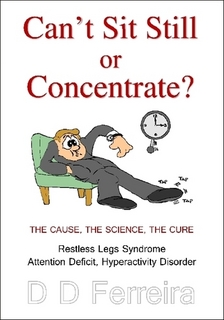
Feeling restless, agitated, or just generally uncomfortable in your own skin and don't know why?
Well,
these symptoms are real, are globally recognised, and have names -
the most well-known being ADHD and RLS - Attention Deficit, Hyperactivity Disorder and Restless Legs Syndrome.
Let's
first consider RLS - which can be described as an uncontrollable urge
to move the legs or a foot in order to exorcise a vague feeling of
discomfort in the legs.
Almost
everyone will have experienced restless legs at some time in their
lives. In fact, clinical RLS is reported to affect five to ten percent
of adults. It is a spectrum disorder, meaning it can range from mild to
disabling, affecting every aspect of one's life.
The other pandemic closely related to RLS is the condition known as Attention Deficit, Hyperactivity Disorder (ADHD).
Similar
neural pathways are affected, and symptoms include inattention,
impulsively, impatience, absent-mindedness. It is also a spectrum
disorder, and mild symptoms can go undiagnosed, so although you may be
doing quite well work-wise and social-wise, you will not generally feel
comfortable, be able to relax, or experience peace.
Paradoxically,
stimulant medications can induce peace, calm, and dramatically improve
focus and concentration (as will tea, coffee etc.).
Unfortunately they also have the potential
to introduce additional problems over the longer term. Caffeine is the
most popular quick fix, but can also have serious side-effects that
most people are unaware of - such as adrenal fatigue, or depression.
And caffeine will lower the RLS threshold - especially when the
stimulant effect wears off after a few hours.
If
these symptoms are mild (subclinical) they will probably go
undiagnosed, so you may be unknowingly living a lower-quality life than
is your right. Fortunately, there is an easy way to find out if your
foods are the cause in which case there is a simple solution.
Click to go to bookstore.